
AI's Bottleneck in Clinical Trials Moved, and Most People Missed It

JP Lee, COO, AG Mednet
John Paul (JP) Lee,
COO, AG Mednet

Insilico just signed another AI-discovery deal. IGC Pharma cut Alzheimer's data prep from 28 hours to two and a half. Snowflake and NVIDIA are putting agentic AI directly into life-sciences data platforms. If you only read the headlines, you'd think the story is that AI is getting faster at finding drugs.

The more interesting story is where the constraint went. For a decade, the rate-limiting step in drug development was discovery — finding a viable molecule. AI has genuinely compressed that. Generative models now surface candidates in a fraction of the time, and the deals reflect it, moving from science-project pilots into structured, milestone-driven pharma partnerships.

The constraint moved into trial operations and data management

But molecules don't generate value. Approved drugs do. And between a promising candidate and an approval sits the part of the industry that AI has been slowest to fix:

  • Running the trial
  • Reconciling data
  • Coordinating sites
  • Keeping the whole apparatus auditable enough to survive regulatory scrutiny

So as discovery speeds up, the bottleneck doesn't disappear. It moves downstream — into trial operations and data management. More candidates, reaching the clinic faster, all funneling into an operational layer that hasn't scaled at the same rate. That's not a discovery problem anymore. It's an orchestration problem.
In a regulated trial, speed isn’t the number that matters

Here's the part that gets underappreciated. IGC's 90% time reduction is real and impressive — but the number that actually matters in a regulated setting isn't speed, it's whether the output is reproducible and auditable. A harmonization that's fast and unverifiable is worthless to a sponsor who has to defend the dataset to the FDA. Snowflake understood this; their entire pitch is governed agents acting on data that never leaves a controlled environment.

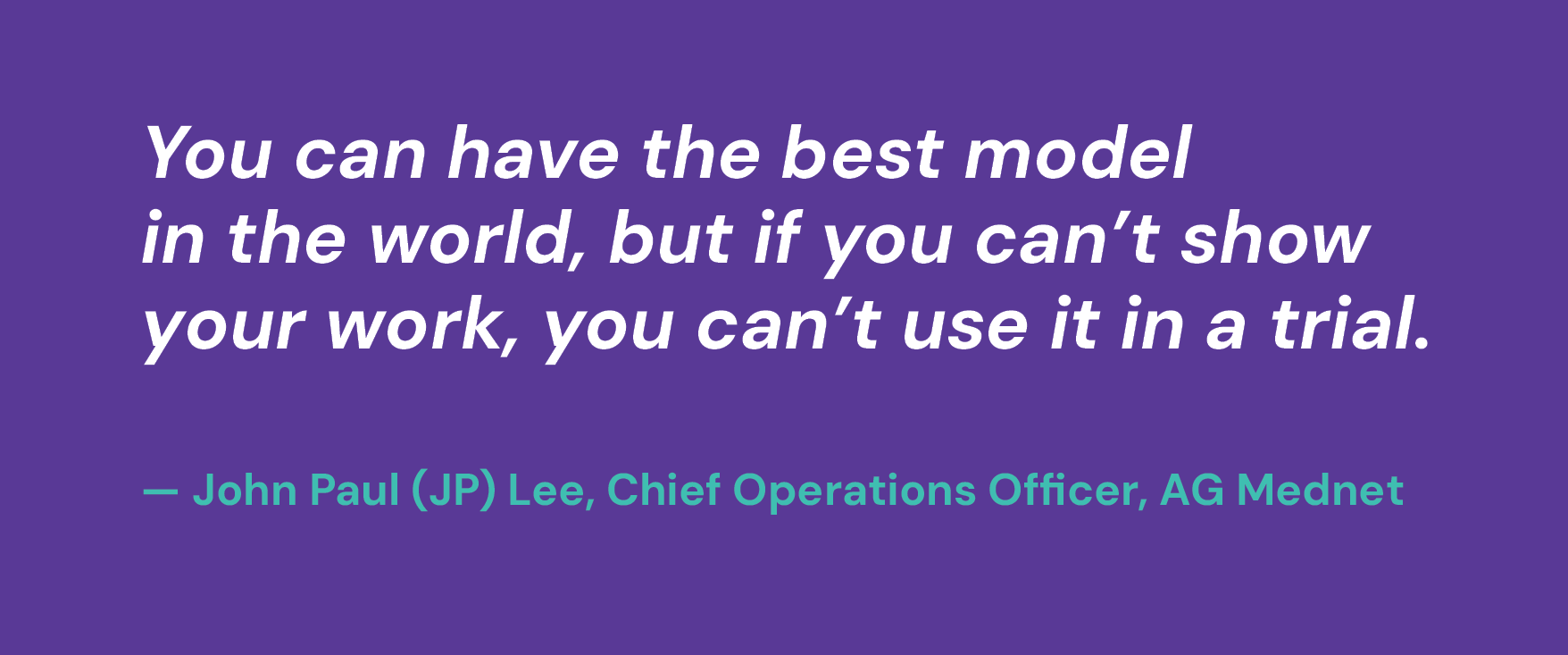
That tells you where the value really sits. Not in the model. In the governance around the model. This is the layer most organizations underinvest in, because it's less glamorous than a new algorithm and harder to demo. It's also the layer that determines whether agentic AI is deployable in a GxP environment at all. You can have the best model in the world, but if you can't show your work, you can't use it in a trial.

The value is in the governance, not the model

This is what we've been building toward at AG Mednet — treating AI not as a feature to bolt on, but as something that has to operate inside a workflow that is accountable by design. Augmenting how trials run, not replacing the people and controls that make the data trustworthy.

The companies that win the next phase won't be the ones with the fastest model. They'll be the ones who made AI's speed auditable.

Where do you think the next bottleneck moves after operations?

JP Lee, COO, AG Mednet

John Paul (JP) Lee, COO, AG Mednet. McKinsey alum and Kellogg MBA, JP drives operational strategy for Judi across regulated clinical trial environments.

AI's Bottleneck in Clinical Trials Moved, and Most People Missed It

JP Lee, COO, AG Mednet
John Paul (JP) Lee,
COO, AG Mednet

Insilico just signed another AI-discovery deal. IGC Pharma cut Alzheimer's data prep from 28 hours to two and a half. Snowflake and NVIDIA are putting agentic AI directly into life-sciences data platforms. If you only read the headlines, you'd think the story is that AI is getting faster at finding drugs.

The more interesting story is where the constraint went. For a decade, the rate-limiting step in drug development was discovery — finding a viable molecule. AI has genuinely compressed that. Generative models now surface candidates in a fraction of the time, and the deals reflect it, moving from science-project pilots into structured, milestone-driven pharma partnerships.

The constraint moved into trial operations and data management

But molecules don't generate value. Approved drugs do. And between a promising candidate and an approval sits the part of the industry that AI has been slowest to fix:

  • Running the trial
  • Reconciling data
  • Coordinating sites
  • Keeping the whole apparatus auditable enough to survive regulatory scrutiny

So as discovery speeds up, the bottleneck doesn't disappear. It moves downstream — into trial operations and data management. More candidates, reaching the clinic faster, all funneling into an operational layer that hasn't scaled at the same rate. That's not a discovery problem anymore. It's an orchestration problem.

In a regulated trial, speed isn’t the number that matters

Here's the part that gets underappreciated. IGC's 90% time reduction is real and impressive — but the number that actually matters in a regulated setting isn't speed, it's whether the output is reproducible and auditable. A harmonization that's fast and unverifiable is worthless to a sponsor who has to defend the dataset to the FDA. Snowflake understood this; their entire pitch is governed agents acting on data that never leaves a controlled environment.

That tells you where the value really sits. Not in the model. In the governance around the model. This is the layer most organizations underinvest in, because it's less glamorous than a new algorithm and harder to demo. It's also the layer that determines whether agentic AI is deployable in a GxP environment at all. You can have the best model in the world, but if you can't show your work, you can't use it in a trial.

The value is in the governance, not the model

This is what we've been building toward at AG Mednet — treating AI not as a feature to bolt on, but as something that has to operate inside a workflow that is accountable by design. Augmenting how trials run, not replacing the people and controls that make the data trustworthy.

The companies that win the next phase won't be the ones with the fastest model. They'll be the ones who made AI's speed auditable.

Where do you think the next bottleneck moves after operations?

JP Lee, COO, AG Mednet

John Paul (JP) Lee, COO, AG Mednet. McKinsey alum and Kellogg MBA, JP drives operational strategy for Judi across regulated clinical trial environments.

Case Study
A Unique Solution for Patient Eligibility Review

Leverage Judi for increased compliance: expedited, high quality, structured decision-making on centralized patient eligibility determination that can eliminate an entire category of important protocol deviations from your trial

DownloadDownload
Case Study
Judi in Remote Monitoring and Medrio EDC Integration

Prominent international biotech partners with Judi by AG Mednet and Medrio for holistic solution to remote monitoring and electronic data capture (EDC) on three-year global clinical program of 10 studies

DownloadDownload
Whitepaper
Navigating the Post-Capture Era of Clinical Trials

From Data Capture to Data Liberation

DownloadDownload
AI's Bottleneck in Clinical Trials Moved, and Most People Missed It

Adjudication

Learn More

Imaging

Learn More

Eligibility

Learn More

Monitoring

Learn More

DSMB

Learn More

Qualification

Learn More
Key Benefits for
AI's Bottleneck in Clinical Trials Moved, and Most People Missed It
Trials

Key Features

Workflow

Create customized workflows per event type, even within a single protocol or program

Electronic Case Report Forms

Enable eCRFs with advanced edit checks and data validation capabilities at any point in the process

De-Identification

Integrated tools enabling removal of protected health information (PHI) from document submissions

Query Management

Manage all event-related queries within the system and keep a log of all interactions

Notifications

Advanced email and web-service notifications to users based on their role

Audit Logging

Robust and compliant audit logging of all actions within Judi

Medical Imaging

Upload, de-identify, store and review medical images as part of endpoint or event submission

Role-to-Role Communications

Specific roles or groups to chat about a case or a project, detailed audit log of all interactions

Robust Reporting Infrastructure

Library of commonly-used reports to provide visibility to a given project’s status or status across a number of projects in a program. Ad hoc reports.

Dashboards and Worklists

Standard and customizable dashboards to help users visualize worklists, case status and project health

Integration

Communicate with EDC and safety systems through a well-defined web-services API

AI-Assisted Redaction

Judi’s proprietary AI-Assisted Redaction capability automatically detects potential inclusions of PHI and flags them for review, saving time and reducing regulatory risk.

Stay up-to-date with whats happening

Some sub copy covering what weekly/monthly update sand news one can expect.

Workflow

Create customized workflows per event type, even within a single protocol or program

Electronic Case Report Forms

Enable eCRFs with advanced edit checks and data validation capabilities at any point in the process

De-Identification

Integrated tools enabling removal of protected health information (PHI) from document submissions

Query Management

Manage all event-related queries within the system and keep a log of all interactions

Notifications

Advanced email and web-service notifications to users based on their role

Audit Logging

Robust and compliant audit logging of all actions within Judi

Medical Imaging

Upload, de-identify, store and review medical images as part of endpoint or event submission

Role-to-Role Communications

Specific roles or groups to chat about a case or a project, detailed audit log of all interactions

Robust Reporting Infrastructure

Library of commonly-used reports to provide visibility to a given project’s status or status across a number of projects in a program. Ad hoc reports.

Dashboards and Worklists

Standard and customizable dashboards to help users visualize worklists, case status and project health

Integration

Communicate with EDC and safety systems through a well-defined web-services API

See Judi in Action; Request a Demo today

Contact us today to learn more about how Judi can automate, expedite, and improve your clinical trials.

Learn More