
Imaging workflows don’t usually fail all at once.
They slip. A required step is missed. A submission arrives late. A scan isn’t analyzable. The downstream impact is familiar: rework, delays or data gaps and missing outcomes that affect critical trial decision-making and increase risk to trial integrity.
Below are four common challenges that derail imaging workflows and practical ways teams can address them.
Challenge 1: Ensure images are protocol-compliant and analyzable
An imaging workflow must ensure images are acquired within the protocol-specified imaging timepoints and according to the technical image acquisition guidelines. Consistency in image acquisition is essential, in order for the core lab to be able to analyze the images and provide the normalized outcomes that are needed for credibility in statistical analyses.
Inconsistencies in imaging techniques and imaging equipment can result in data variability, images that can’t be analyzed, and missing outcomes.
Solution
To mitigate these risks and prevent critical data loss, best practice is for core labs and clinical teams to:
- Provide comprehensive site training on imaging windows, image acquisition, and the image submission process.
- Supply a detailed image acquisition guideline that clearly defines identification requirements, scan collection instructions, and recommended parameters across modalities.
- Implement a test data validation process for complex imaging requirements, so sites submit test images before producing study data, and the core lab can confirm that acquisition parameters meet protocol requirements before any actual trial data are captured.
- When needed, conduct equipment qualification, to ensure scanners can generate images that comply with the study’s technical and scientific specifications.
This combination of imaging study start-up strategies allows teams to be deliberate and proactive with their approach to imaging process design. With clear expectations around imaging requirements and timelines, and with the use of test data validation and/or equipment qualification procedures as appropriate, the imaging component of the trial will be off to a smooth start.
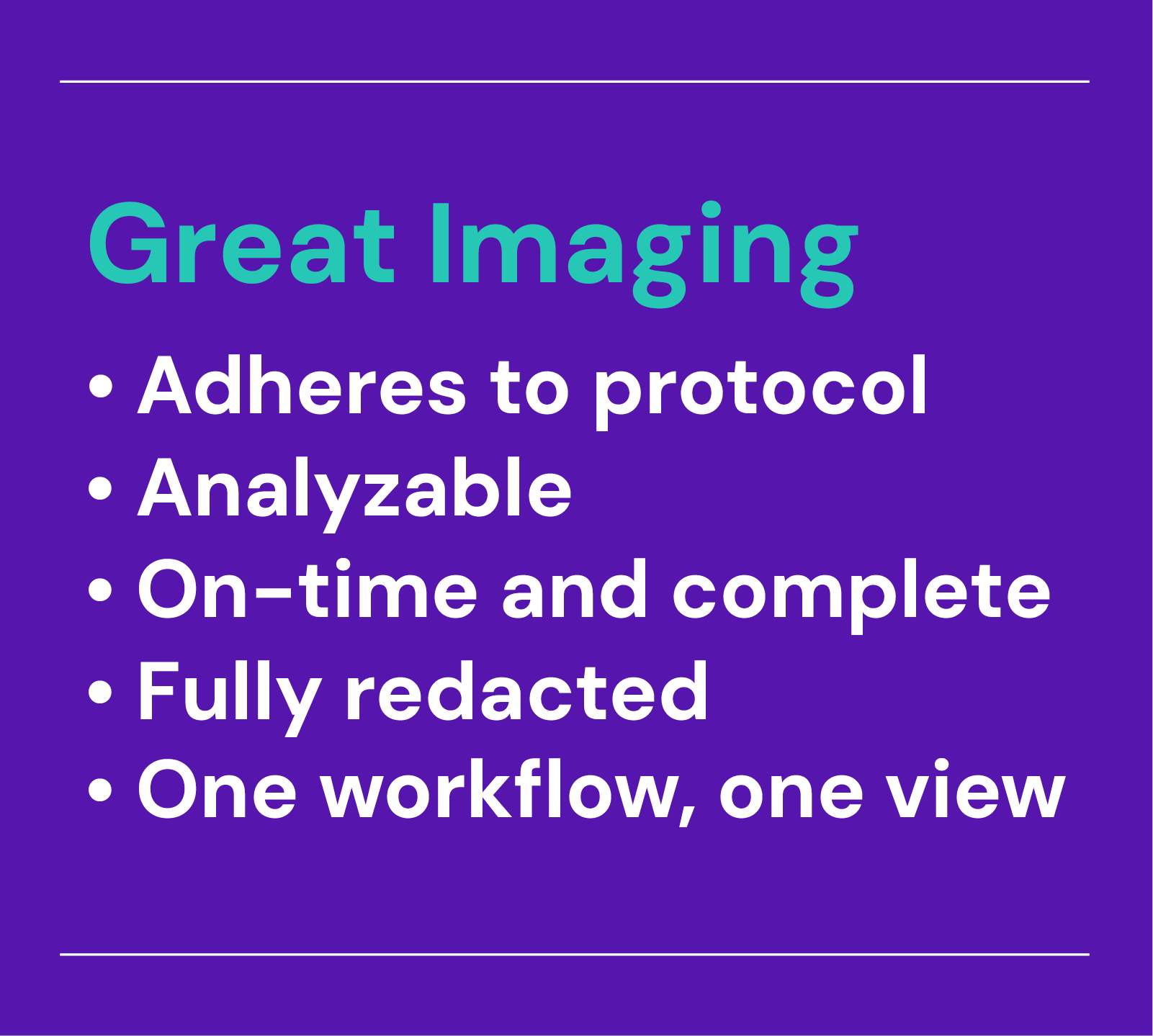
Challenge 2: Obtain timely image outcomes for critical decision-making
Timeliness is a major focus for any imaging workflow. Sites must acquire images within the windows established in the protocol’s schedule of events, as out-of-window images cannot be analyzed for study outcomes. How images are transmitted also matters; courier shipment creates lengthy delays and adds cost, so best practice is to implement a platform that facilitates secure online collection. Even then, active management is essential — comparing images received versus expected and following up with sites to ensure all submissions arrive within required turnaround times. Core lab turnaround times are equally critical and should be a key factor in partner selection.
When an imaging workflow slows or stalls, the consequences can be high – slow enrollment, missed deliverables, deferred critical decision-making, study delays and budget overruns.
Solution
To obtain rapid imaging outcomes and keep imaging trial timelines on track, best practice is for teams to:
- Implement secure online collection of digital images, to reduce courier-driven delay and cost.
- Use automated site reminders for upcoming or overdue image submissions, to prevent missed imaging windows and late image submissions.
- Run continuous, automated reconciliation between images expected and received, to confirm completeness of image collection.
- For global trials, choose imaging partners with a global footprint and regional expertise, including culturally and linguistically aligned communication and 24/7 multilingual technical support, to reduce friction from regional barriers (including network restrictions and local internet policies).
This multi-layered strategy to streamline and expedite all steps of the end-to-end imaging workflow is a critical success factor for any imaging trial. Image outcomes have far-reaching impacts that can be highly time-sensitive: they can determine eligibility for patient enrollment and, as endpoint outcomes, they can inform trial-wide conclusions, including DSMB recommendations and interim analysis decisions.
Challenge 3: Protect confidentiality with compliant image redaction
Protecting patient confidentiality and complying with data protection laws like HIPAA and GDPR are non-negotiable. Risks arise from sensitive information embedded in DICOM headers, the images themselves and structured reports. If PHI/PII redaction is not handled consistently and completely, breaches of privacy are violations that can lead to serious consequences, including but not limited to audit findings, suspension or termination of a clinical trial, lawsuits, and hefty fines.
Teams need a clear redaction approach that is easy for sites and other users to execute consistently with high quality and completeness.
Solution
To safeguard confidentiality with requisite compliance, best practice is for teams to:
- Train sites on PHI/PII redaction requirements, study-specific redaction rules and image-specific redaction methods.
- Use a HIPAA- and GDPR-compliant platform for image collection.
- Leverage an automated process that removes PHI/PII as well as protocol identifiers and other information from DICOM tags.
- Include on-screen prompts and reminders at upload, so sites remember to also perform pixel redaction before submitting images.
- Provide built-in redaction tools that are tailored to imaging workflows and easy for users to apply.
- Perform QC and secondary redaction, as needed, after receipt of images from sites.
With the right process, training, and tools in place, teams can address the risk of PHI/PII escape and support compliant submissions across sites and regions.
Challenge 4: Avoid sprawl
When the coordination of information for imaging workflows sprawls across fragmented tools, scattered trackers, and disparate email chains, it becomes hard to tell where each image stands and where the next step action lies. Status is unclear, manual effort is needed to identify and address gaps, manual follow-up to chase missing data or resolve queries is time-consuming, issues take longer to resolve, and late or missing images lead to critical data loss.
Over time, this sprawl adds noise to the workflow and makes it harder for sites, core labs, CROs, and sponsors to stay focused, deliver an efficient process, and meet study objectives.
Solution
To proactively prevent workflow complexity, facilitate collaboration while aiming for decreased manual effort, fewer manual handoffs and increased transparency with a single source of truth, best practices include:
- Use a single, shared workspace where all stakeholders can collaborate on end-to-end imaging workflows.
- Design streamlined, scalable processes using proven online process maps.
- Implement process automation and centralized tracking to reduce effort and provide real-time status visibility.
- Use integrated query management to centralize communication, improve data quality, and track resolution.
- Include automated reminders to expedite task completion and keep timelines on track.
- Leverage consolidated dashboards and detailed reports to provide all process stakeholders with tailored views of image workflow status.
With an online imaging platform that drives efficiency through process management and collaboration, reduces manual effort and handoffs through automation and provides clearer visibility across process stakeholders, teams can reduce friction, resolve issues faster and successfully manage image data with confidence – ensuring completeness, quality, and timeliness of imaging outcome data.
Imaging Success Doesn’t Happen by Accident
Successful imaging is a balance of planning, process, technology, and expertise. Leveraging best practice to build quality into every aspect of process design is an essential foundation. Success depends on efficient execution at each step – how images are acquired, processed, submitted, and analyzed. It also very much depends on how issues are prevented, and how well they are identified and addressed when they can’t be prevented. Small breakdowns in any area of the process often show up later as rework, delays or data gaps, and missing outcomes — which can have far-reaching negative impacts along a study’s critical path.
Clear image acquisition guidance, efficient online image collection and processing, coordinated end-to-end image management, and centralized expert technical analysis by a core lab are solutions teams can use to reduce avoidable friction and smooth the path to obtaining the rapid, high-quality imaging outcomes that are needed to achieve key study objectives and make reliable critical trial decisions.
For a deeper look at how teams are designing imaging workflows for optimized performance, watch our recent webinar where industry experts discuss practical strategies and best practices for setting up and managing imaging in clinical trials.